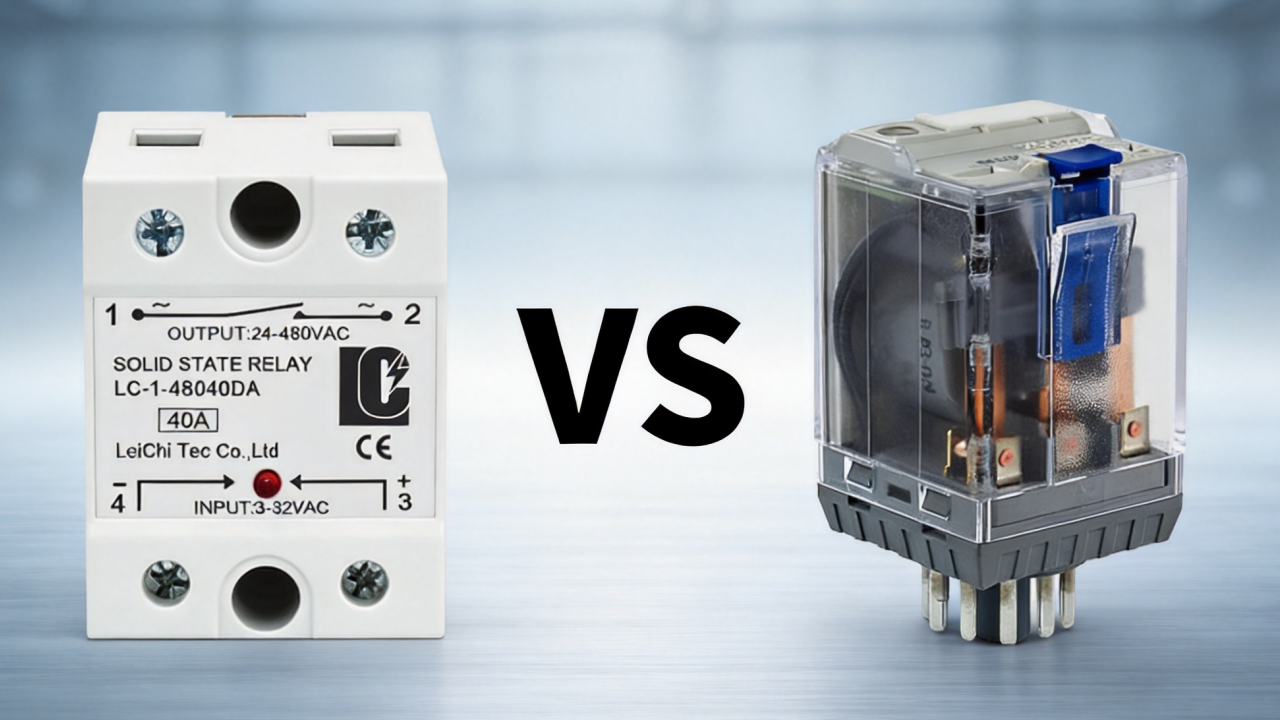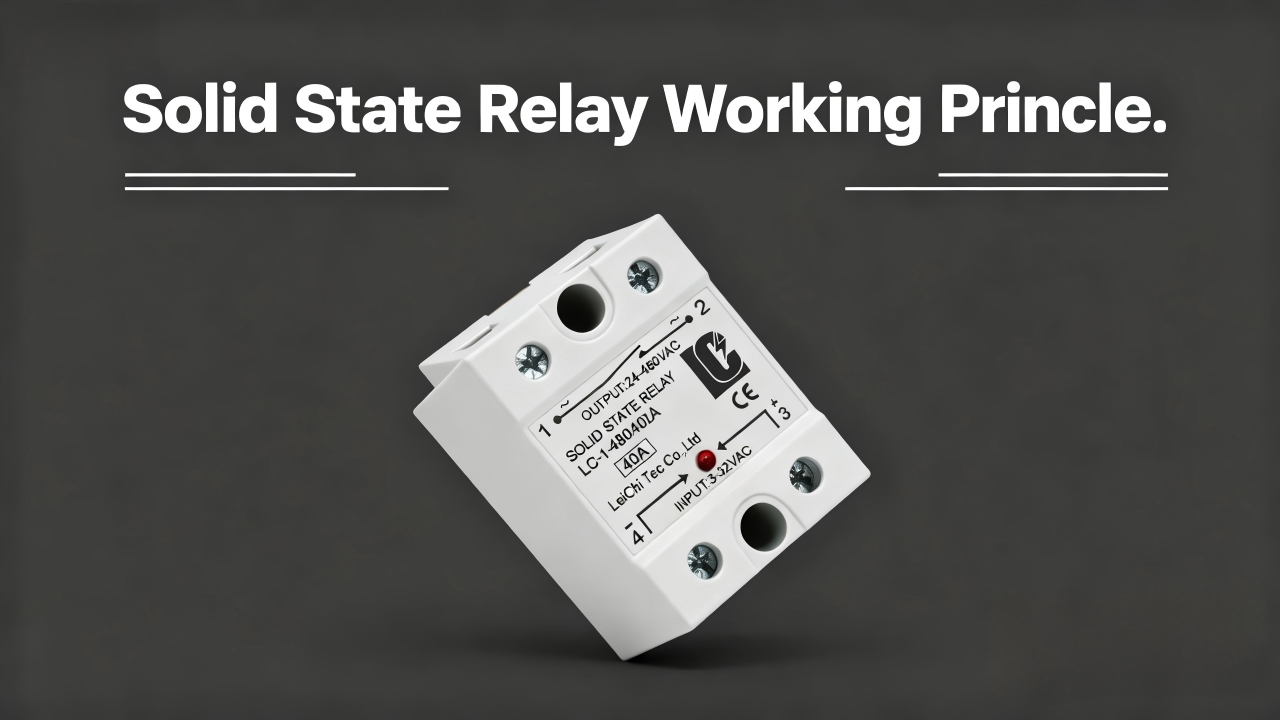
Choosing the right solid state relay can effectively improve the efficiency of the equipment. In this article, we will explore the working principles, advantages and areas of application of zero-crossing SSRs to help you choose the most suitable switching type for your application.
What is a Zero-Crossing SSR
A zero-crossing solid state relay is an electronic switch that uses semiconductor switching, and it is typically used only for AC loads.
Zero-Crossing SSR Definition
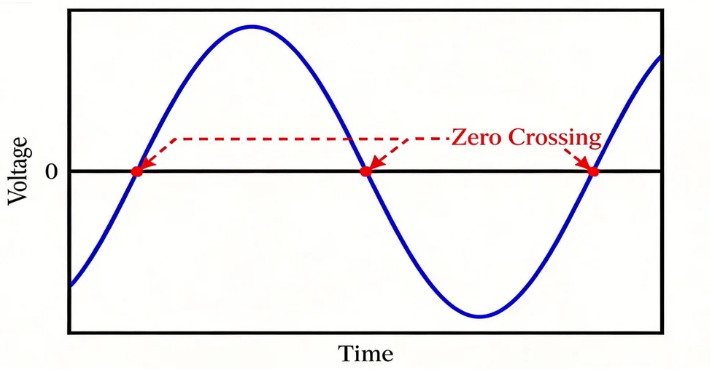
The AC voltage has a periodic waveform with recurring zero-crossing points. And the zero-crossing SSR is a solid state relay that turns on when the AC voltage waveform approaches the zero-crossing point.
When a control signal is applied, a zero-crossing SSR does not immediately turn on; instead, it waits for the voltage to approach the zero-crossing point before turning on the output.
This approach helps reduce switching transients and electrical noise, commonly used in applications such as industrial heating and temperature control.
Zero-Crossing SSR Working Principle
First, a control signal is applied; the control terminal receives the input signal, which drives the optocoupler, thereby creating electrical isolation between the input and output sides.
The zero-cross detection circuit monitors the AC voltage waveform; when the AC voltage waveform transitions from the positive half-cycle to the negative half-cycle, or from the negative half-cycle to the positive half-cycle, the instantaneous voltage is near the zero-crossing point.
The output semiconductor device, either a TRIAC or an SCR, is triggered, thereby supplying current to the AC load.
As long as the control signal remains applied, the output semiconductor device remains conducting, and the load continues to operate. Once the control signal is removed, the output semiconductor device turns off when the load current naturally approaches zero.
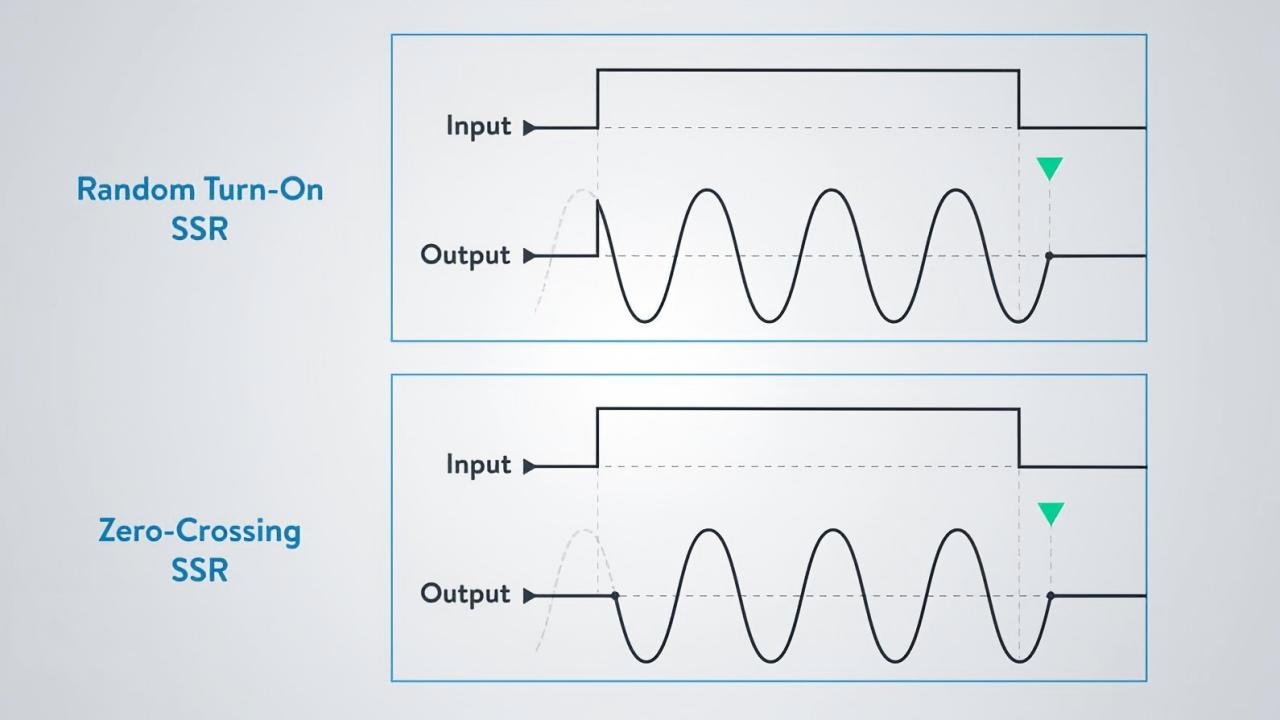
Zero-Crossing SSR VS Random Turn-On SSR
The fundamental difference between the two lies in their turn-on timing. A zero-crossing solid state relay turns on only when the AC voltage waveform is near the zero-crossing point.
A random turn-on solid state relay can turn on at any point in the AC waveform; there is no need to wait for the voltage to approach the zero-crossing point.
In addition, there are several other fundamental differences that allow you to choose the most suitable switching method based on specific loads and requirements.
| Feature | Zero-Crossing SSR | Random Turn-On SSR |
| Turn-on timing | Limited by the AC zero-crossing point | More flexible |
| Switching transient | Generally lower | Generally higher |
| Switching noise / EMI | Generally lower | Generally higher |
| Resistive loads | Well suited | Suitable |
| Phase-angle control | Not suitable | Suitable |
| Typical applications | Heaters, heating elements, temperature control systems | Phase-angle control and applications requiring precise turn-on timing |
| Main advantage | Reduces switching transients and electrical noise | Provides flexible control over the AC waveform |
| Main limitation | Cannot control the exact turn-on point of the AC waveform | May generate greater switching transients and electrical noise |
| Response Time | Generally slight delay | Generally faster |
Key Benefits and Best Applications for Zero-Crossing SSRs
Compared with random turn-on solid state relays, the zero-crossing relay helps you reduce switching transients, electrical noise, electromagnetic interference, and electrical stress during turn-on, and is well suited to a variety of applications where switches need to be switched frequently without requiring precise control of the AC waveform.
Key Benefits of Zero-Crossing SSRs
The main advantages of zero-crossing solid state relays include reduced switching transients, lower switching-related electrical noise, and suitability for frequent AC ON/OFF switching.
- Reduced Switching Transients
A zero-crossing SSR turns on when the AC voltage waveform approaches the zero-crossing point; compared with turning on at a higher instantaneous voltage, this method results in a lower initial voltage being applied to the load.
Switching transients are also typically lower, which can reduce transient disturbances and overvoltages affecting the power supply system.
Moreover, in certain applications, this method can also reduce inrush current.
- Lower Electrical Noise and EMI
Zero-cross switching reduces voltage spikes and high-frequency transient components during turn-on, helping to minimize electrical noise and EMI associated with switching.
This reduces interference with your control circuits and sensor signals, making the system more works well in industrial systems with a high density of electronic equipment.
- Suitable for Frequent AC Switching
Because of SSRs’ working principle and their use of semiconductor switching devices, non-mechanical contacts, distinct from mechanical relays, SSRs are not subject to contact wear during switching; furthermore, “zero-cross” switching technology minimizes electrical interference caused by frequent switching operations. It is more appropriate for your equipment subject to frequent AC ON/OFF cycles.
- Reduced Electrical Stress During Turn-On
Because the load is switched on when the AC voltage is close to zero, a zero-crossing SSR can reduce the electrical stress associated with turning on an AC load at a higher instantaneous voltage.
Best Applications for Zero-Crossing SSRs
- Industrial Heating
For industrial heating equipment that typically requires frequent AC ON/OFF switching, it is not necessary to precisely control the phase angle of the AC waveform; this allows for smoother switching transitions.
Typical equipment includes industrial heaters, heating elements, ovens, and furnaces.
- Temperature Control Systems
In temperature control systems, solid-state relays frequently turn on and off based on the output of the temperature controller; therefore, minimizing electrical noise and associated electromagnetic interference helps reduce disturbances to other control circuits and nearby equipment.
- Plastic Processing Equipment
This typically involves multiple heating zones, each of which requires separate temperature control. Zero-crossing SSRs can be used to control the various heating elements, enabling frequent switching and temperature adjustment in each zone. Typical Applications include injection molding machines and plastic extrusion equipment.
- Packaging Equipment
Packaging equipment used for heat sealing, shrink wrapping, and thermal cutting requires fast and periodic switching control; this makes zero-crossing SSRs a suitable choice for your AC heating loads in the packaging industry.
- HVAC and Electric Heating Systems
Zero-crossing SSRs can control AC heating elements and perform repeated switching operations based on control signals, effectively reducing switching transients and electrical noise.
Please note that zero-crossing SSRs are not the optimal choice for all AC loads, so if you need precise AC waveform control, a random turn-on SSR is more suitable.
FAQ
What Types of Loads are Suitable for Zero-Crossing SSRs?
Zero-crossing solid state relays are well suited to AC loads requiring frequent switching but not demanding precise AC waveform control, particularly for resistive loads such as heating elements.
In addition to resistive loads, zero-crossing SSRs can also be used for certain inductive loads, provided that the SSR ratings and switching characteristics are commonly used with the load. The SSR must be capable of handling the load’s inrush current, dv/dt, and switching stresses.
For applications requiring precise control and phase-angle control, random turn-on SSRs are more suitable.
Does a Zero-Crossing SSR Need a Heat Sink?
A heat sink is not always necessary; whether a heat sink is required depends primarily on factors such as load current, power dissipation, mounting conditions, and ambient temperature.
Zero-cross solid state relays generate heat during conduction, particularly in applications with high currents or continuous loads.
Therefore, if you need a heat sink, select one by taking into account factors such as the rated current of the zero-crossing SSR, actual load current, ambient temperature, mounting conditions, and the thermal performance of the SSR.
Can a Zero-Crossing SSR be Connected Directly to a PLC?
Yes. If the PLC’s output specifications match the zero-crossing SSR input requirements, they can be connected directly.
Before making connections, ensure that the PLC’s output voltage, output current, and output type are compatible, and verify compatibility in terms of electrical specifications and wiring requirements.
What Happens If a Zero-Crossing SSR Fails?
A common failure mode is an output short circuit, which can cause the load to remain powered even after the control signal is removed.
Using appropriate SSR ratings, providing adequate heat dissipation, and installing suitable protective devices helps reduce the risk of failure caused by overload or overheating and mitigate the consequences of an SSR failure.
How Can I Test a Zero-Crossing SSR?
As with SSR, testing a zero-crossing SSR first requires an input control signal and an output switch operation.
First, check whether the input terminal is receiving the correct control voltage, after connecting a suitable AC load, check whether the solid state relay turns on and off in response to the application and removal of the control signal.
Please note that this article, “How to Test a Solid State Relay: A Step-by-Step Guide”, can be used as a reference for the specific test method. Additionally, please note that the operation does not occur immediately after applying the control signal; instead, the system waits until the AC voltage approaches the zero-crossing point.
Final Thoughts
Selecting the appropriate switching method for the SSR is crucial for achieving reliable control of the load. LCTC offers a wide range of solid state relay series, and most SSR types are available with different switching methods.
If you need a zero-crossing or random turn-on SSR, we can recommend the most suitable option for your application. You may contact our technical team for assistance in making your selection.